Mentafy · Advanced Reporting System
Advanced Authorship Report
Designing a paragraph-level writing-pattern analysis experience for academic institutions.
The Advanced Authorship Report, also called the In-Document View, gives educators a forensic-level breakdown of how a document was written, revised, and sourced. It was designed as the investigative layer behind Mentafy's standard Authorship Report.
View live feature ↗Challenge
Beyond the summary report
The standard Authorship Report gave educators a high-level authenticity score, but when that score raised concerns, there was nowhere to go. The investigation had to happen outside the platform, manually, with no structured context.
The challenge was not adding more data, but building a forensic experience that educators could trust and that students couldn't easily dispute.
Designing for complexity
Five writing categories, one readable view
The In-Document View needed to surface five distinct writing-behaviour classifications at the paragraph and sentence level, without overwhelming the reviewer. The visual language had to be immediately readable even without a legend, and the colour system unambiguous across different user contexts.
A three-tier risk scale sits above the five behaviour categories, so a reviewer reads urgency before detail, and never needs the legend to know where to look first.
Process & exploration
How the design developed
Final design experience
The delivered In-Document View
Feature 01
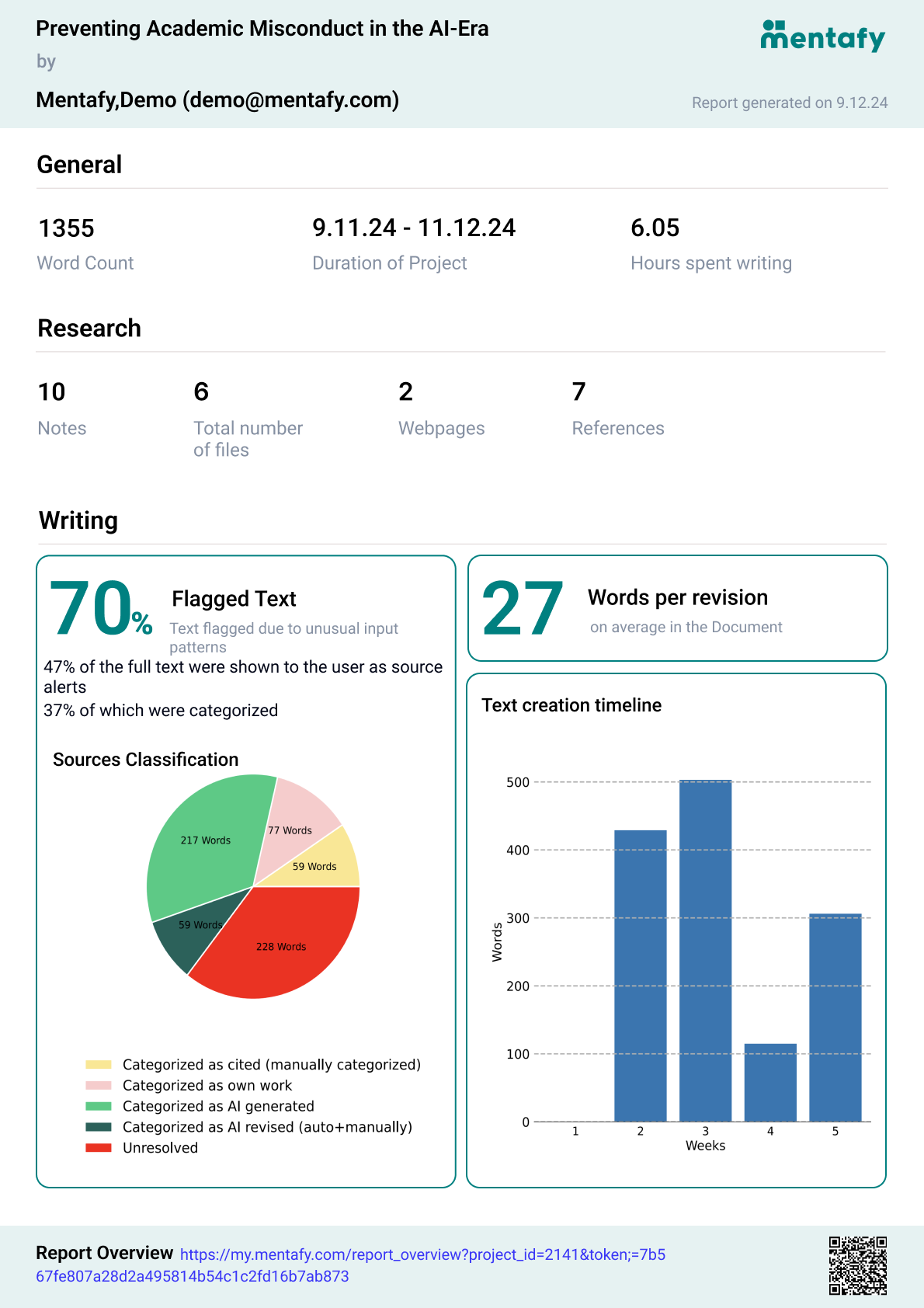
Unusual text & classification metrics
Two numbers orient the reviewer before they read a single paragraph. Unusual % shows how much of the document does not appear naturally human-written; Unclassified % shows what portion of that lacks any documentation or citation.
Together they guide whether deeper investigation is warranted. For 80–90% of students, it isn't.
Feature 02
Severity-ranked findings panel
The Findings Panel lists every flagged section ranked by severity, so reviewers see the most critical cases first. Each finding shows its writing-behaviour type, document location, and source-classification status.
Clicking a finding takes the reviewer directly to the highlighted passage in context, with a detailed explanation of when and how it was written.
Feature 03
Writing session analysis
Writing data is grouped into sessions, starting when the author opens their document and ending when they close it or take a long break. Each session records word count and duration.
Sudden large text insertions in a single session are a strong signal of misconduct; gradually developed sessions suggest a natural writing process. This view makes document evolution legible.
Feature 04
Layered plagiarism check
When the writing-process analysis flags suspicious patterns, a second layer cross-checks the flagged content against web and publisher databases. The source is identified and linked directly inside the report, so the reviewer has both the behavioural evidence and the origin in one view.
This distinction matters: writing-pattern analysis comes first; database matching follows only when needed.
Design principles
What guided the work
Outcome
Impact of the redesign
The Advanced Authorship Report established the investigative layer that the standard report had always implied but never delivered: a structured, evidence-based tool for handling integrity cases that respects both the reviewer's time and the student's right to context.
Reflection
The challenge was not visual styling. It was helping users trust the data.
Every decision, from the severity ranking to the session view to the two-layer analysis, had to serve a specific kind of user judgment. A feature used to investigate potential misconduct has to be both powerful and precise. Designing for that stakes level requires a different kind of restraint.